
Views: 0 Author: Site Editor Publish Time: 2026-01-30 Origin: Site
Imagine you are driving down a mountain pass with your family. The sun is setting, and the road ahead is a series of tight, unpredictable curves. In those moments, you aren’t thinking about the hydraulic valving or the nitrogen pressure beneath your chassis. You are trusting that your vehicle will respond exactly when you turn the wheel or tap the brakes. This trust is built on a foundation of invisible engineering, specifically on the rigorous world of shock absorber testing. A shock absorber is one of the few components in a car that is truly "safety-critical," yet most drivers never see it.1 Because it is hidden away, the only way to guarantee its performance is through a gauntlet of quality standards that separate a reliable component from a dangerous one.
In this comprehensive guide, we are going to pull back the curtain on the world of quality control. We will explore the international benchmarks that every shock absorber must meet, the high-tech machinery used to simulate years of road abuse in just a few days, and the data-driven metrics that professional manufacturers use to ensure your ride is both smooth and safe. Whether you are an automotive professional or a car owner who simply wants to understand the science of safety, this deep dive into shock absorber testing will show you exactly what it takes to make a world-class suspension component.
Quality control in the suspension industry isn't just about ensuring a product looks good on a shelf; it is about life and death. The shock absorber is responsible for keeping tires in contact with the road.2 If the quality control process fails, the consequences can be catastrophic. A sudden seal failure or a snapped mounting bracket during a high-speed maneuver can lead to an immediate loss of vehicle control.
Effective quality control ensures that every shock absorber rolling off the assembly line performs identically to the prototype that was meticulously designed by engineers. Without standardized shock absorber testing, there would be no way to account for variations in raw material batches, welding integrity, or hydraulic fluid purity. Quality control acts as the final gatekeeper, ensuring that only the components capable of withstanding the violent forces of the road ever reach the consumer.3
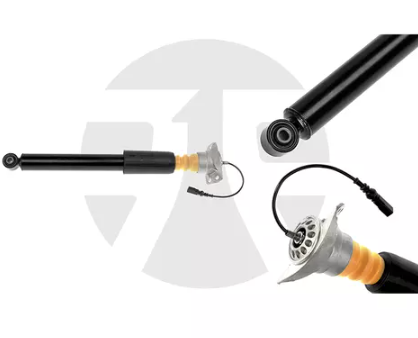
In the global automotive market, a shock absorber isn’t just a part; it is a promise of stability. To ensure that this promise is kept, the industry relies on a hierarchy of international standards. These aren't just suggestions; they are the laws of the manufacturing land.
The most fundamental of these is ISO 9001, which establishes the baseline for quality management.4 However, for a shock absorber destined for modern passenger or commercial vehicles, the industry looks toward IATF 16949. This is the "gold standard" for automotive quality management. It focuses specifically on defect prevention, the reduction of variation, and the elimination of waste in the supply chain. When a shock absorber manufacturing facility is IATF 16949 certified, it means every process—from the sourcing of raw steel to the final hydraulic fill—is tracked, measured, and optimized.
We also cannot overlook the regional benchmarks provided by the SAE (Society of Automotive Engineers) and DIN (Deutsches Institut für Normung). These organizations provide the specific technical requirements for shock absorber materials and performance.5 For example, DIN standards might specify the exact hardness of the chrome plating on the piston rod, while SAE standards define how the shock absorber should behave during high-speed oscillations.
The most important part of shock absorber testing happens on the dynamometer, often referred to as "the dyno." A shock absorber is essentially a hydraulic dampener, and its job is to control the energy of the vehicle's springs.6 To measure how well it does this, we use the dyno to subject the shock absorber to various speeds and strokes, recording the resistance force it generates.
During shock absorber testing, we look at two primary charts: the Force-Velocity (F-V) curve and the Force-Displacement (F-D) curve.7 The F-V curve is critical because it shows how the shock absorber reacts at different speeds. At low velocities, the shock absorber manages the "body roll" of the car when you turn a corner.8 At high velocities, it manages the sudden impact of a pothole.
We also look for symmetry between compression (when the shock absorber is pushed in) and rebound (when it pulls back out). While most vehicles require more force in the rebound phase to control the spring's energy, the transition between the two must be seamless. Any "damping lag" or aeration in the hydraulic fluid will show up immediately on the dyno as an irregular line, indicating that the shock absorber will provide a noisy or unstable ride.
Roads are unpredictable, but a shock absorber must be predictable for its entire life. This is where endurance testing comes into play. We use high-frequency fatigue testers to simulate an entire lifetime of driving in just a few weeks.
In a typical endurance test, a shock absorber is subjected to millions of continuous cycles. For most OEM applications, the benchmark is between 1 million and 5 million cycles. During this test, the unit is under constant load, causing the internal hydraulic fluid to reach extreme temperatures. We monitor the unit for any signs of "damping degradation"—the point where the shock absorber loses its ability to control the spring due to fluid breakdown or valve wear.
Beyond just moving up and down, a shock absorber is often subjected to lateral (side) forces, especially during sharp cornering.9 Side-load testing measures the strength of the piston rod and the internal bushings. We also perform "pothole simulation," where the shock absorber is hit with a sudden, massive force to ensure the base mounts and the outer housing do not deform or snap.
A shock absorber is exposed to the elements every single day. From the freezing slush of winter to the scorching heat of a desert highway, the materials must remain stable.
One of the most grueling tests is the Salt Spray Test (ISO 9227). The shock absorber is placed in a chamber and blasted with a highly corrosive salt fog for hundreds of hours. This test evaluates the quality of the paint, the zinc plating, and the chrome on the piston rod. If the rod develops even a tiny speck of rust, it will act like sandpaper against the rubber seals, causing a leak.
Temperature has a massive effect on hydraulic oil.10 We test units in thermal chambers that cycle from -40°C to +120°C. At -40°C, we ensure the oil doesn't become so thick that the shock absorber seizes. At +120°C, we ensure the oil doesn't become so thin that the damping force disappears. This temperature resilience is what makes a shock absorber reliable whether you are in Alaska or Arizona.
To help you understand what separates a premium component from a standard one, it is helpful to look at the data. The following table highlights the difference between standard industry requirements and high-performance benchmarks.
| Test Parameter | Industry Standard Requirement | High-Performance Benchmark | Impact on Driving |
| Damping Force Tolerance | ± 15% | ± 3% - 5% | Balanced handling on both sides |
| Endurance Cycle Life | 1 Million Cycles | 5 Million Cycles | Long-term reliability |
| Salt Spray Resistance | 240 Hours | 1000+ Hours | Prevents rust in snowy regions |
| Low-Speed Friction | < 30 N | < 10 N | Improves comfort on small bumps |
| Burst Pressure | 60 Bar | 120+ Bar | Safety during extreme impacts |
As the data shows, high-performance shock absorber testing pushes the component far beyond the minimum requirements. This extra margin of safety is what protects you when you hit a pothole you didn't see.
At the end of the day, all this technical data and all these machines serve one purpose: to keep your vehicle stable. When a shock absorber meets or exceeds these quality standards, the benefits to the driver are tangible.
First, there is the reduction in braking distance. A tested, high-quality shock absorber prevents the "nose-dive" that happens when you slam on the brakes.11 By keeping the car level, it ensures that the rear tires maintain contact with the road, providing up to 20% more braking power in an emergency. Second, there is the prevention of hydroplaning. A worn or poorly tested shock absorber allows the tire to "hop" on the water's surface. A strong shock absorber presses the tire down, cutting through the water and maintaining grip.
Finally, there is the reduction in driver fatigue. A shock absorber that has been tuned and tested for low friction and consistent damping provides a quiet, smooth ride. You arrive at your destination feeling refreshed rather than exhausted by constant vibrations.
As we have explored, the journey from a raw steel tube to a finished, safety-critical component is one of extreme rigor. The standards we use—ISO, IATF, SAE, and others—are the quiet sentinels that guard our roads. When you choose a shock absorber that has been subjected to millions of cycles, blasted with salt, and measured to the micrometer, you are choosing more than just a car part. You are choosing peace of mind.
At Tianyi, we understand the weight of that choice. We don't just see a shock absorber as a product on a shelf; we see it as a promise we make to every driver who trusts our engineering. We’ve spent years refining our shock absorber testing protocols because we believe that "good enough" is never enough when it comes to safety. We are a team of people who are passionate about the science of the smooth ride and the mechanics of stability.
Every unit that carries the Tianyi name has been through the gauntlet. We push our components to their absolute limits in our labs so that they will never reach their limits on your road. We take pride in the transparency of our testing and the precision of our manufacturing. For us, the greatest reward isn't a certification on a wall—it's the knowledge that when you're driving through that mountain pass at sunset, our shock absorber is doing its job perfectly, silently, and safely.
We love being a part of your journey, and we’re always here to help you understand the technical heartbeat of your vehicle. Let's keep your ride steady and your safety certain, one mile at a time. After all, you have a destination to reach, and we’re here to make sure you get there comfortably and safely.


